
Comparison guide
KNX vs Zigbee vs Wi-Fi vs DALI: which smart home system for a Bangalore home?
A bus cable to every keypad and sensor, run before plastering.
- Without internet
- Keeps working
- Retrofit
- Low
- Best for
- New builds
Wireless. A module behind each switch; most need a neutral at the switch box.
- Without internet
- Works through the hub
- Wiring
- Existing wiring
- Grows
- Mesh
Each device joins the router, so large homes depend on strong Wi-Fi everywhere.
- Without internet
- Depends on the product
- Hub
- None
- Best for
- Budget setups
A lighting layer: each light dims on its own, usually through a KNX-DALI gateway.
- Control
- Per light
- Works with
- Often KNX
- Wiring
- Pre-ceiling
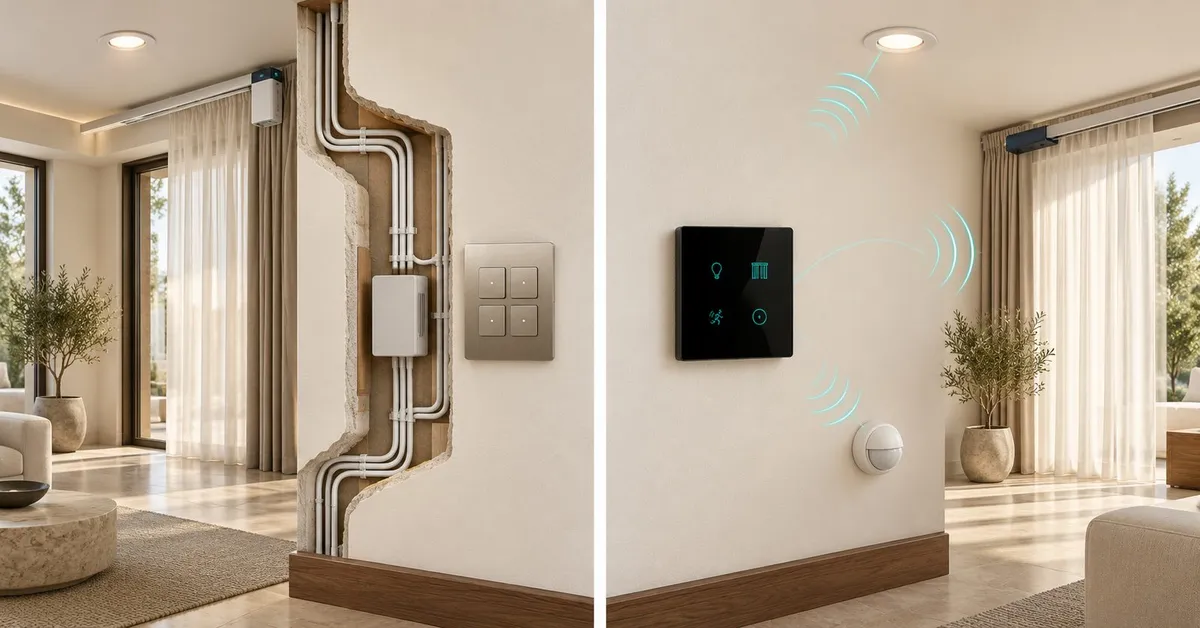
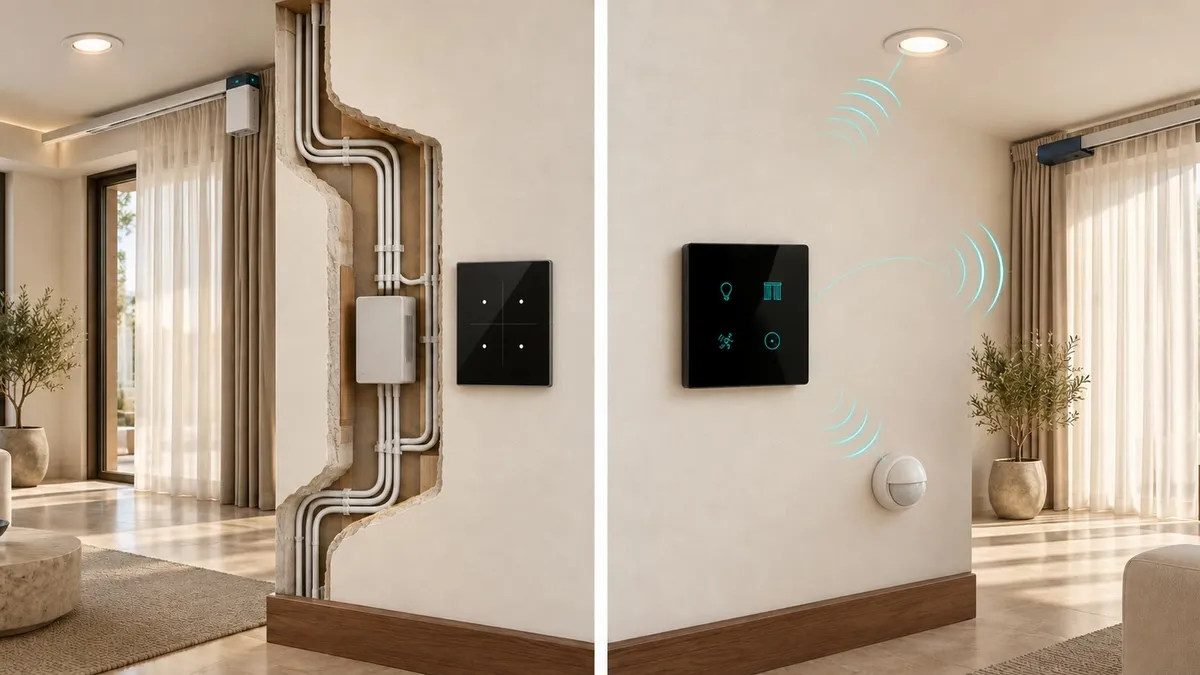
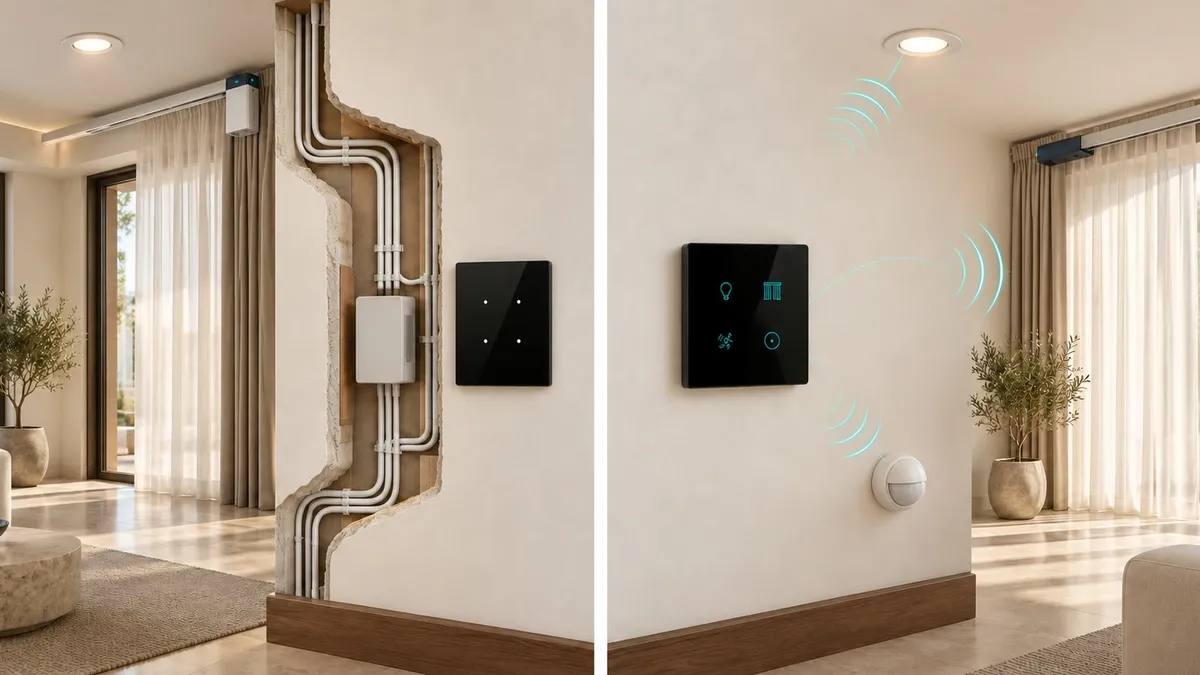
Side-by-side comparison
General technical differences, plus what we install for each. Relative cost only; your quote comes from the design.
| Feature | KNX | Zigbee | Wi-Fi | DALI |
|---|---|---|---|---|
| Wiring needs | A bus cable to every keypad and sensor, run before plastering; switching modules in the distribution board. | Wireless. A module behind each switch; most need a neutral at the switch box. | Wireless. A module behind each switch; most need a neutral at the switch box. | A control cable to each light driver, run before the ceiling closes. |
| Without internet | Keypads, scenes and sensors keep working; control runs on the bus. | Devices talk to the hub by local radio, so switches and scenes keep working while the hub is powered. | Depends on the product; many rely on the router and the maker’s app. | Lighting control runs on its own wiring, locally. |
| In a power cut | Off with the mains unless the KNX power supply and modules are on backup; programming is kept. | Hub and switch modules go off without backup; the hub keeps its setup and the mesh reforms when power returns. | Switches and router go off without backup; devices reconnect to Wi-Fi when power returns. | Drivers go off without backup; each light returns to a set power-on level. |
| Scalability | Grows across floors on the same bus; best planned for the whole home up front. | Mesh grows as you add mains-powered devices; easy to add rooms later. | Each device joins the router, so large homes depend on strong Wi-Fi everywhere. | Grows by lighting circuit; usually planned room by room for lighting. |
| Retrofit friendliness | Low. Adding it after plastering means breaking walls or surface conduit. | High. Works with conventional wiring. | High. Works with conventional wiring. | Low. Needs control wiring to the lights. |
| Standard | Open standard (ISO/IEC 14543-3) used by many manufacturers. | Open wireless standard (Zigbee 3.0) used by many brands. | Mostly each brand’s own app and setup. | Open lighting-control standard (IEC 62386). |
| Relative cost | Higher | Mid | Lower | Higher (added to the lighting wiring) |
| Switch brands we install | Ekinex, MDT, GVS, Eelectron and Moorgen KNX lines | Moorgen Zigbee range, Stoic (our own touch switches) and Control4 Lux | Our budget packages only | Controlled from KNX keypads or the automation system |
| Best fit | New construction and full renovations, planned before plaster. | Renovations and finished homes, without breaking walls. | Budget setups and small, simple homes. | Premium dimmable or tunable lighting, usually alongside KNX. |
KNX: wired, for new builds and full renovations
KNX is a wired building-control standard. Keypads, sensors and switching modules share one dedicated bus cable, and the modules sit in the distribution board. Because it changes how the house is wired, KNX has to be decided before plastering, and it is programmed by the installer.
Brands we install: Ekinex, MDT, GVS, Eelectron and Moorgen's KNX lines. Control4 is a separate platform with its own wired keypads.
Zigbee: wireless, for renovations and finished homes
Zigbee is a low-power wireless mesh standard. Switches and sensors talk to a hub by radio, with no separate control cable, so it works with conventional wiring and can be added room by room. Mains-powered devices extend the mesh; battery sensors need the occasional battery change.
Brands we install: the Moorgen Zigbee range, Stoic (our own touch switches) and Control4 Lux.
Wi-Fi: simple, for budget setups
Wi-Fi switches join your home router directly, with no hub. That keeps a small setup simple, but every device depends on the router, and large homes need strong Wi-Fi coverage in every room. Most need a neutral at the switch box.
We use Wi-Fi switches only in our budget packages.
For a finished 3BHK, Stoic EI, EX and PX are Wi-Fi (no hub) and ZXD and ZXC are Zigbee (add a gateway): Wi-Fi or Zigbee smart switches for a finished 3BHK.
DALI: a lighting-control layer
DALI is a wired lighting-control standard for dimming and colour-temperature control of individual lights. It is not a whole-home system on its own; it is a lighting layer, often paired with KNX so the same keypads and scenes control it. Like KNX, its control wiring has to go in before the ceiling closes.
Where Thread and Matter fit
Thread is a low-power wireless mesh network, like Zigbee, and uses the same kind of 2.4 GHz radio. Thread devices speak IP and reach your home network through a Thread border router, which is built into some smart speakers and hubs. Thread only carries the data.
Matter is a common application standard from the Connectivity Standards Alliance. It runs over Wi-Fi, Thread or Ethernet and uses Bluetooth only to set devices up. A Matter device can be controlled locally and by more than one ecosystem at once, such as Apple Home, Google Home and Alexa. Matter is not a wiring system, so it does not replace KNX or DALI. Zigbee devices can join Matter only through a hub that bridges them.
Our view: we don't recommend a Matter-first build yet, because device support is still uneven. For most homes, a Zigbee or KNX system today, with Matter-compatible devices added as the standard matures, is the safer choice.
What happens in a power cut or internet outage
Bangalore homes see both, so it's worth knowing how each system behaves. In all four, programming is stored in the devices or hub, so nothing needs to be set up again afterwards.
- KNX. Power cut: the bus runs from a KNX power supply in the distribution board, so without backup it goes off with the lights. When power returns, each module goes to the state set during programming. Internet outage: no effect on keypads, scenes or sensors; only remote app access and voice control stop.
- Zigbee. Power cut: the hub and the switch modules go off without backup; battery sensors stay on but have nothing to talk to. When power returns, the hub keeps its setup and the mesh reforms, which can take a few minutes. Whether each light comes back on or off depends on the device's power-on setting. Internet outage: switches and scenes keep working if the hub runs them locally.
- Wi-Fi. Power cut: switches and router go off without backup, and devices reconnect to the router when power returns. Internet outage: many products rely on the maker's cloud app, so app control and schedules can stop even though the router is on. The physical switch usually still works.
- DALI. Power cut: drivers and the DALI bus power supply go off without backup. DALI drivers have a programmable power-on level, so lights return to a known brightness. Internet outage: no effect, because control runs on the DALI wiring.
If the KNX power supply, the Zigbee hub or your router is on an inverter or UPS circuit, the system keeps working for the loads that backup supports. Which circuits go on backup is worth settling with your electrician before wiring.
Decide before plastering
KNX and DALI change the electrical layout, so they can't wait. If you're not sure yet, wire so KNX stays possible. The pre-plaster smart home checklist lists what to settle with your architect and electrician first.
Want to see the switches? Browse the designer switch gallery and use its System filter to show KNX or Zigbee designs.
How we decide on your project
- ₹3,000 automation design site visit, adjusted against your final invoice. We look at the construction stage, the wiring, your budget and how you use each room.
- Design before install. A documented design and a fixed-price quote before any installation starts.
- A Homezee Site Report after every visit.
- Warranty: a 1-year comprehensive full-system warranty covering hardware, wiring and programming, serviced by our in-house team.
We've installed systems in 200+ homes since 2019, across Karnataka and Hyderabad. See how we work.
Questions we get about choosing a system
- Which smart home system is best for a new build in Bangalore?
- For a new build, KNX is usually the strongest choice, because the bus cable can be run before plastering and the system does not depend on Wi-Fi or a cloud app. If the budget is tighter or you want to start small, Zigbee also works in a new build and can be added room by room. KNX home automation in Bangalore
- Can I add KNX after plastering?
- Only with civil work: a KNX bus cable has to reach every keypad and sensor, so adding it after plastering means breaking walls or running surface conduit. If the walls are already finished, Zigbee is normally the practical choice. Pre-plaster smart home checklist
- Can Zigbee work without internet?
- Yes, Zigbee itself does not need internet: switches, sensors and the hub talk to each other over local radio. You need internet for remote app access and voice assistants, and some hubs use the cloud for certain features, so the hub choice matters.
- Is Wi-Fi fine for a villa?
- Wi-Fi switches can work in a villa, but every device joins your router, so the whole house needs strong Wi-Fi coverage on every floor. For whole-villa automation we usually recommend KNX or Zigbee, and we use Wi-Fi switches only in our budget packages.
- What is DALI, and do I need it?
- DALI is a wired lighting-control standard for dimming and colour-temperature control of individual lights, and it is often paired with KNX. You only need it if you want premium dimmable or tunable lighting and can run its control wiring before the ceiling closes.
- Can KNX and Zigbee be used in the same home?
- Yes. Many homes use KNX for the main lighting and curtain control and Zigbee for devices added later, such as locks, sensors or curtains in rooms finished after the wiring stage.
- Do smart switches need a neutral wire?
- Most Zigbee and Wi-Fi smart switches need a neutral at the switch box, and Stoic switches need one at every box. KNX keypads take their power from the bus cable instead, but the KNX switching modules in the distribution board are wired to the circuits. Neutral wires in the pre-plaster checklist
- Which switch brands does Homezee Smart Solutions install for each system?
- For KNX we install Ekinex, MDT, GVS, Eelectron and Moorgen’s KNX lines; for Zigbee, the Moorgen Zigbee range, Stoic (our own touch switches) and Control4 Lux. Wi-Fi switches are part of our budget packages only. Browse the designer switch gallery
- Should I wait for Matter instead?
- We don’t recommend a Matter-first build yet, because device support is still uneven. Most homes asking about Matter are better served today by a Zigbee or KNX system, with Matter-compatible devices added as the standard matures.
- What is Thread, and how is it different from Zigbee?
- Thread is a low-power wireless mesh network, like Zigbee, and uses the same kind of 2.4 GHz radio. The difference is that Thread devices speak IP, the language of the internet, and reach your home network through a Thread border router. Thread only moves data; Matter is usually what runs on top of it.
- Is Matter a replacement for Zigbee or KNX?
- Not directly. Matter is a common language for smart devices that runs over Wi-Fi, Thread or Ethernet, so devices from different brands can work with Apple Home, Google Home and Alexa together. It is not a wiring system like KNX, and existing Zigbee devices can join Matter only through a hub that bridges them.
- What happens to a smart home in a power cut?
- Without backup power, the automation goes off with the lights. KNX, Zigbee, Wi-Fi and DALI systems keep their programming, so nothing needs to be set up again. When power returns, KNX modules and DALI drivers go to a set state, the Zigbee mesh reforms, and Wi-Fi devices reconnect. If the KNX power supply, hub or router is on an inverter or UPS, the system keeps working for whatever loads that backup supports.
- Does a smart home work during an internet outage?
- KNX and DALI work fully without internet, because control runs on their own wiring. Zigbee switches and scenes keep working if the hub runs them locally. Many Wi-Fi switches rely on the maker’s cloud app, so app control can stop, although the physical switch usually still works. Remote access from outside the home and voice assistants need internet on every system.
- How do you decide which system my home gets?
- We decide at the ₹3,000 automation design site visit, which is adjusted against your final invoice: we look at the stage of construction, the wiring, your budget and how you live in the home. You get a Homezee Site Report after the visit and a documented design and fixed-price quote before any installation. See how we work
Not sure which system fits?
Tell us your construction stage and home type on WhatsApp, and we'll tell you which system makes sense before you book the design visit.
WhatsApp +91 80884 40322 · How we work · More guides